

Setting a bankroll before you play is a foundational habit a casino player can build. It turns gambling from a financial risk into a controlled expense, much like a night out or a concert ticket. A Manitoba player can combine percentage betting with session limits, lower-house-edge game selection, and, where applicable, the Kelly Criterion. For example, deciding in advance how much to risk on blackjack or baccarat keeps the focus on a defined entertainment budget.
I’ve tested these approaches myself over years of casual play, and a plan keeps losses within defined limits in a way winging it never does. My test used a $500 bankroll split across four sessions, a strict loss limit, and a deliberate focus on low-house-edge table games, the same structure covered in the sections below.
Understanding Your Gambling Bankroll
Your gambling bankroll is the money you’ve set aside specifically for play, nothing more. Use only disposable income, meaning funds left over after rent, bills, groceries, and savings are handled. If a loss would hurt your ability to pay for essentials, that money doesn’t belong in a casino game. That applies whether you’re planning to play craps or European roulette.
A separate account or e-wallet helps keep gambling funds distinct from everyday spending. When the balance hits zero, play stops. This practical boundary protects you from the slippery slope of dipping into bill money when luck runs dry. It also means a losing craps session or a bad run at the European roulette wheel doesn’t justify transferring more money into play.
This site’s own responsible-gambling guidance lists warning signs worth taking seriously. These include chasing losses with bigger bets, gambling with money set aside for bills or essentials, lying to people close to you about how much time or money you’re spending, feeling unable to stop even when you want to, and using gambling to escape stress or a low mood. If any of these sound familiar, that’s a signal to step back and reassess.
The Percentage Betting System
Beginners often stake a small percentage of their total bankroll per session or per bet. Protect your bankroll from the natural swings of chance so one bad run doesn’t wipe you out. A player might apply the same discipline to a blackjack bet rather than increasing the stake after a loss, while treating slots as another reason to keep the percentage modest because outcomes can move quickly.
Conservative players often stake around 1% of their bankroll per session. Moderate players might use 2-3%. Aggressive players push toward 5%. These figures are heuristics that balance risk against the chance of meaningful wins. Beginners can use the 1% rule and adjust as they learn their own tolerance for variance.
A $500 bankroll can be split across four sessions. Each session gets $125. If you lose that amount, you stop for the day. If you win, you bank the profit and keep your next session stake the same. This structure prevents the common mistake of increasing bet sizes after a win, which often leads to giving those winnings right back.
Session Limits and Time Management
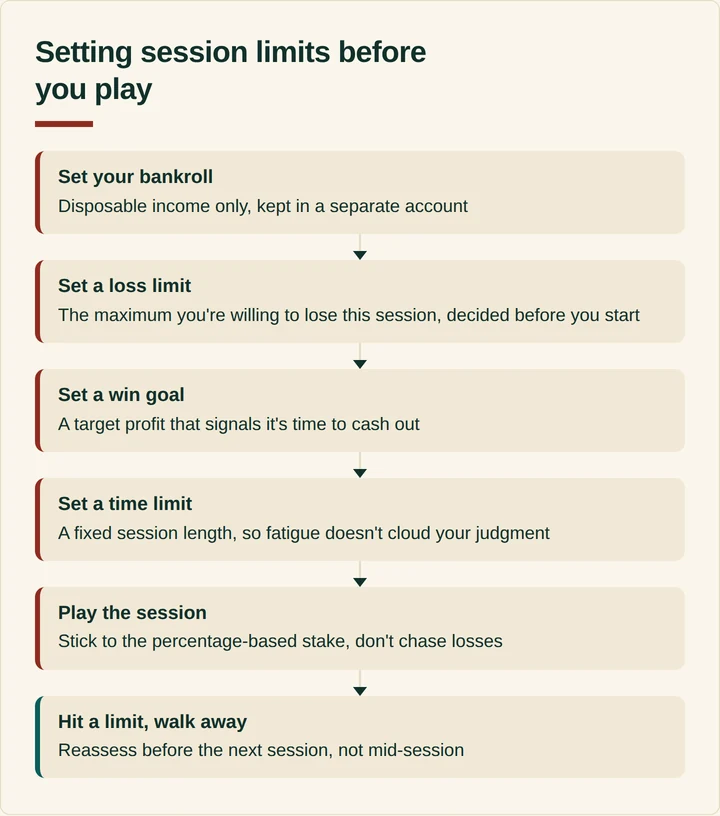
Several limits matter more than any betting system. They include a loss limit, a win goal, and a time limit. A loss limit is the amount you’re willing to lose in one session. When you hit it, you walk away. A win goal is the opposite, a target profit that signals it’s time to cash out. A time limit keeps you fresh and prevents fatigue from clouding your judgment. Whether the session involves baccarat or a spin at European roulette, the limits should be set before play begins.
For Manitoba players, help is available if gambling stops being fun. MBLL’s responsible-gambling program includes GameSense information tools and a Voluntary Self-Exclusion program covering MBLL venues and PlayNow.com. Enrollment is handled directly through MBLL. The Manitoba Gambling Helpline, at 1-800-463-1554, is free, confidential, and available 24 hours a day. The Addictions Foundation of Manitoba, at afm.mb.ca, offers free counselling for problem gambling, and Community Financial Counselling Services can help with the financial side. Readers outside Manitoba should look to their own province’s equivalent services.
These tools exist because gambling works best as entertainment, with limits that keep it separate from financial planning. Setting limits before you play and sticking to them separates a hobby from a problem.
Game Selection and House Edge
The house edge is the mathematical advantage the casino holds over players in any given game. It’s built into the rules and cannot be outsmarted. Over time, the house edge determines how much of every dollar wagered the casino keeps on average.
| Game Type | Typical House Edge | Bankroll Volatility |
| Blackjack (basic strategy) | ~0.5–1% | Low to medium |
| Baccarat (banker bet) | ~1.06% | Low |
| Craps (pass/don’t-pass) | ~1.4% | Medium |
| European roulette (single zero) | ~2.7% | Medium |
| Slot machines | Low single digits to mid-teens | High |
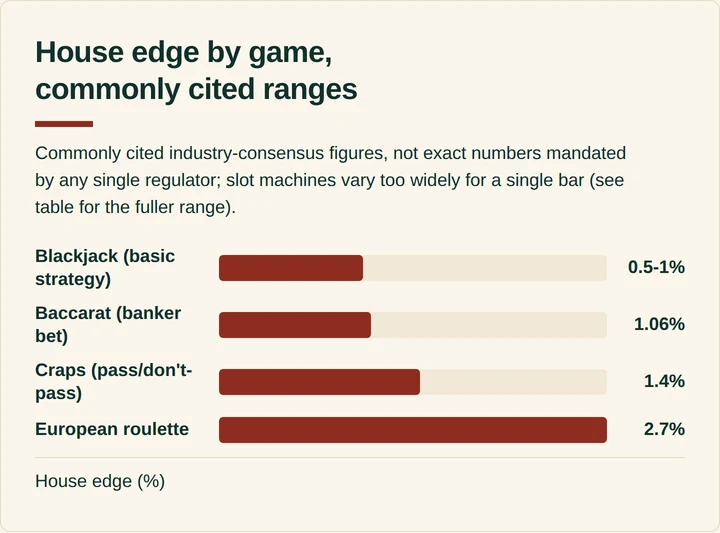
These figures are commonly cited industry-consensus ranges and serve as practical benchmarks. Lower-house-edge games give you more play for your money. Blackjack with correct basic strategy, baccarat’s banker bet, and craps’ pass line are among the better bets in a casino. Slots carry a much wider range of house edges and higher volatility, meaning your bankroll can swing more dramatically.
There’s no single regulator-mandated minimum RTP that applies universally to online slots. The UK Gambling Commission requires RTP disclosure but does not mandate a minimum percentage. A slot advertised with a 96% RTP has a theoretical return over millions of spins, not a guarantee for any single session.
Prioritizing lower-house-edge games reduces the expected loss per dollar wagered and can extend play at the same budget. The odds remain unchanged, and your bankroll stretches to provide more entertainment for the same money.
The Kelly Criterion for Advanced Players
The Kelly Criterion is a bet-sizing formula originally developed for information theory and later applied to betting. The formula uses your edge and the odds. The fraction of your bankroll to wager equals your edge divided by the odds. If you have a genuine edge, Kelly sets a stake size intended to maximize long-term growth.
The Kelly Criterion is mathematically appropriate when the bettor has a genuine positive expected value. Most casino games do not meet that condition because the house edge makes the expected value negative. In a game of pure chance with a house edge, Kelly’s formula would tell you to bet zero because the math says you shouldn’t bet at all.
Players who find games with a real skill component, like poker or sports betting where you have an actual edge, can use Kelly to set a stake fraction based on that edge. For casino games played against the house edge, it is largely theoretical. A fractional Kelly approach, betting half or a quarter of what the formula suggests, is a common compromise for those who want to use the concept without the full risk.
Avoiding Common Bankroll Mistakes
Several mistakes sink more bankrolls than any others. These include chasing losses, ignoring variance, playing without limits, and mixing bankrolls.
Chasing losses is the classic trap. You lose $100, so you bet $200 to win it back. You lose again, and then bet $400. The math never works in your favor. Each bet still carries the house edge, and you’re now risking more to recover money that’s already gone. Set a hard loss limit before you play.
Ignoring variance means expecting smooth, predictable results. Even a game with a 1% house edge can produce long losing streaks. A $500 bankroll can vanish in an hour of bad luck at a $25 blackjack table. Understanding variance helps you set bet sizes that survive the swings.
Playing without limits is the root cause of most bankroll problems. No loss limit, no win goal, and no time limit leave you playing until something forces you to stop. That something is usually an empty bankroll.
Mixing bankrolls means dipping into savings, bill money, or funds earmarked for other purposes when your gambling bankroll runs dry. It’s the fastest way to turn a hobby into a financial crisis. Keep gambling funds separate, and when they’re gone, they’re gone.
Frequently Asked Questions
What percentage of my income should I allocate to gambling?
A commonly used guideline is 1-5% of monthly disposable income, after all essential expenses are covered. This range keeps gambling within the bounds of entertainment and away from financial strain. Start at the lower end and adjust only if you’re comfortable with the losses.
How many sessions should I split my bankroll into?
Many players divide a bankroll into 4-8 sessions, depending on how often they play. If you play weekly, a monthly bankroll split into four sessions works well. The key is that each session’s stake is small enough that losing it doesn’t hurt.
What’s the best game for a small bankroll?
Blackjack with correct basic strategy offers one of the lowest house edges at roughly 0.5-1%, making it a lower-cost option than games with higher edges. Baccarat’s banker bet at 1.06% is another low-edge option. Both give you more play for your money than slots, which typically carry a higher house edge and more volatility.
How do I know if my gambling is becoming a problem?
Watch for these warning signs. They include chasing losses with bigger bets, gambling with money set aside for bills, lying about time or money spent, feeling unable to stop, or using gambling to escape stress. If any of these apply, the Manitoba Gambling Helpline at 1-800-463-1554 is free and available 24/7. AFM at afm.mb.ca offers free counselling.