

Gambling online is enjoyable entertainment when you treat it as disposable spending (money you can afford to lose completely). Decide before you log in what you can afford to lose, and never let a session push past that line. This guide covers the practical tools and habits that keep play recreational. That means budgets, casino limits, breaks, and knowing when to step away. I’ve organized it around the moments where most players drift into trouble, so you can spot them early.
Set Your Budget First
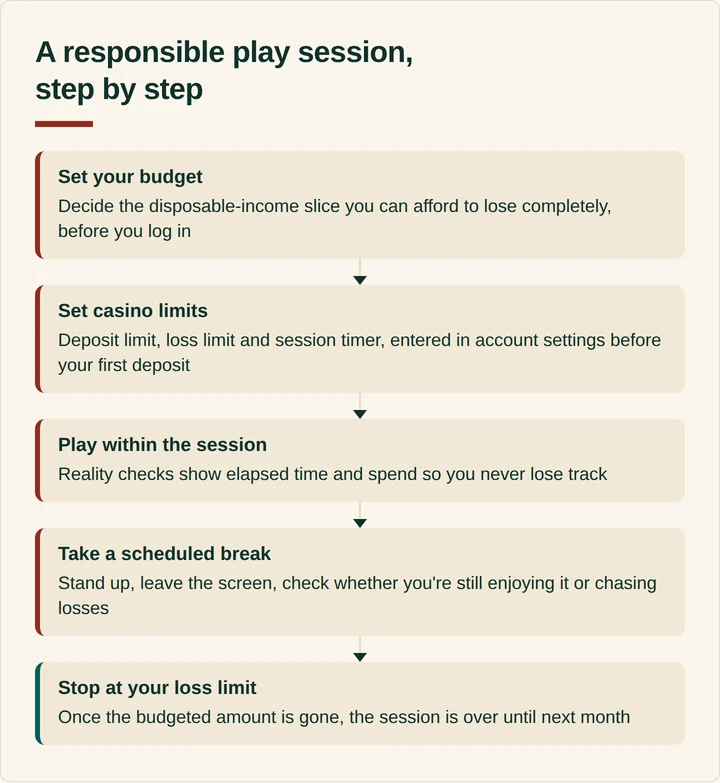
The single most effective rule I know is to separate gambling money from bill money before you ever open a casino site. Never gamble with rent, groceries, or savings. Wagering money you need for essentials turns entertainment into financial risk.
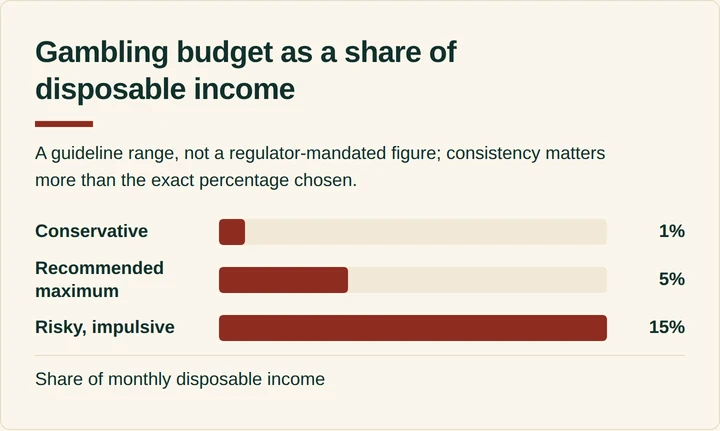
Treat gambling as a small slice of your disposable income, somewhere in the 1–5% range. Choose an amount small enough that losing it entirely wouldn’t affect your week. This prevents gambling from becoming a financial strain. If you have $200 of monthly fun money, allocate a small portion to gambling. Someone earning more might allocate a larger amount, but it should still feel trivial relative to their monthly income.
Whatever amount you choose, deposit it once and stick to it. When it’s gone, it’s gone until next month. No second deposit. No dipping back in for “one more try.” The discipline of that single deposit breaks the cycle that turns entertainment into loss-chasing.
The percentage matters less than the consistency. A player who sticks to 2% every single month is safer than one who uses 5% sometimes and 15% when they’re feeling lucky. Pick your range, write it down, and treat it like a bill you pay to yourself for entertainment.
Master the Essential Tools
Every licensed casino offers responsible-gambling tools. Most players never open the settings menu to find them, which is a missed opportunity. These tools do the self-control work for you, removing reliance on willpower during a losing streak.
Key Tools to Use
- Deposit limits — cap how much you can add to your account daily, weekly, or monthly
- Loss limits — stop you from losing more than a set amount in a given period
- Session timers — remind you how long you’ve been playing
- Reality checks — pop up at set intervals to show your time and spend so far
I always recommend setting a deposit limit before your first deposit, while you’re still making the decision clearly. Waiting until after a few sessions means you’re already familiar with the sting of losses. The Responsible Gambling Council notes that players who use these tools report better control over their play. Setting a limit takes about two minutes in most casino account settings. You can usually lower it instantly but need a cooling-off period to raise it, creating a friction point that stops impulsive increases.
The tools work best in combination. A deposit limit stops you from adding funds; a session timer catches prolonged play over five hours that drains your balance slowly. Set all four if your casino offers them; there’s no downside to having the guardrails in place.
Take Regular Breaks
Casino games are designed to keep you in flow. The lights, sounds, and near-misses all pull toward “one more spin.” A deliberate break breaks that rhythm. I’ve found that stepping away for even ten minutes every hour changes how I evaluate whether to keep playing. Set a timer on your phone before you start. When it goes off, stand up, get water, look at something that isn’t a screen. Leave the chair for a few minutes; a proper break resets your perspective, while a quick tab-away just delays the next spin.
Breaks also help you check your emotional state. Ask yourself if you’re still enjoying this or if you’re trying to win back what you lost. If you’re chasing losses, the break becomes an exit point where you’ve caught the pattern before it deepens. Players who take scheduled breaks report making clearer decisions about when to stop. Without that reset, momentum carries them through until the account is empty.
Never Chase Your Losses
Chasing losses is the fastest route from recreational play to problem gambling. The logic feels compelling (“I’m due for a win”), but each spin or hand is independent of the last. A slot that hasn’t paid in an hour has no higher chance of paying on the next spin than it did on the first. I’ve watched this pattern escalate. You lose $50, deposit another $50 to win it back, lose that again, then deposit $100 because “it can’t keep losing.” A $50 bad night spirals into a $300 loss through this exact mechanism. The loss you’re chasing was already spent the moment you placed the bet; it isn’t coming back because you want it to.
Set a loss limit before you play and treat it as absolute. If you’ve lost your budgeted amount, close the casino and step away for the day. Walking away after hitting your loss limit separates entertainment from problem gambling. The casino’s edge ensures the house wins over time; your only “win” comes from capping your total spend upfront.
Recognize Warning Signs Early
Problem gambling rarely appears overnight. It creeps in through small shifts in behavior that are easy to rationalize in the moment. Early recognition of these signs significantly improves outcomes, according to the Journal of Gambling Issues.
Common warning signs include spending more than you planned, borrowing money to gamble, lying about how much you’ve lost, and feeling restless or irritable when you try to cut back. Another red flag is using gambling to escape stress or negative feelings. When you start gambling to cope rather than to enjoy, gambling has crossed from recreation into self-medication.
Checking your balance repeatedly during the day, even when you’re not playing, is another warning sign. That mental preoccupation (planning the next session while at work or with family) signals the activity has moved past recreation. Two or more of these signs together demand action, not dismissal as a passing phase.
Catching these signs early makes them easier to address. A player who recognizes they’re spending too much can reset their limits and budget. One who waits until debt piles up faces a much harder road back.
Know When to Seek Help
If you’ve recognized warning signs and found you can’t control your play on your own, help is available, and it’s free. You don’t need to hit rock bottom to call. Reaching out early is strength, not weakness.
For readers in Manitoba, the Manitoba Gambling Helpline at 1-800-463-1554 is free, confidential, and available 24/7. The Addictions Foundation of Manitoba (AFM) at afm.mb.ca also offers free counselling for problem gambling. Both are local, both are confidential, and neither will judge you for calling.
If you’re outside Manitoba, your own province runs an equivalent free helpline. A quick search for your province’s gambling support service will find it. The numbers differ, but the help is equally available and free. Make the call.
A helpline isn’t a commitment to quit forever. It’s a conversation with someone who understands how gambling problems develop and can point you to the right support, whether that’s counselling, self-exclusion, or just someone to talk through your situation with. The hardest step is dialing; after that, the process is straightforward.
Use Self-Exclusion When Needed
For players who’ve decided gambling isn’t working for them, self-exclusion enforces the decision by blocking your access entirely. You can’t change your mind in a weak moment if the door is locked. This removes the temptation to override your own resolve.
In Manitoba, MBLL’s Voluntary Self-Exclusion program covers MBLL venues and PlayNow.com/mb directly. Enrollment is handled through MBLL. You choose between temporary exclusion, ranging from six months to five years, and permanent exclusion. During that period, the operator is obligated to refuse your play and remove you from marketing lists.
The temporary option is worth considering if you’re unsure about quitting permanently. Six months away from gambling gives you space to reset your habits and evaluate whether you can return to controlled play. Many players find that after the exclusion period ends, they no longer feel the pull to return.
Other provinces run their own programs. Ontario, for instance, has a province-wide exclusion system, but the mechanics are similar everywhere.
If you’re in Manitoba, MBLL’s program is the one that applies to you. The enrollment process is straightforward, and the relief of not having to exercise willpower every day is substantial.
FAQ
What percentage of my income should I budget for gambling? A reasonable guideline is 1–5% of your disposable income (the money left after essentials like rent, bills, and groceries). This small percentage keeps gambling within entertainment limits and prevents financial strain. The exact figure matters less than sticking to it consistently month after month.
What are the warning signs of a gambling problem? Common signs include spending more than planned, borrowing money to gamble, lying about losses, feeling irritable when trying to cut back, and gambling to escape stress. If you notice several of these, the Manitoba Gambling Helpline can help you sort out next steps.
Can I remove deposit limits once I’ve set them? Most licensed casinos let you lower a deposit limit immediately but require a cooling-off period of 24–72 hours to raise one. That delay exists to stop impulse decisions, and the UK Gambling Commission mandates a version of this cooling-off rule for exactly that reason.
What should I do if someone I know has a gambling problem? Approach them with compassion and avoid lending them money, which often enables the behavior. Let them know about the Manitoba Gambling Helpline and the Addictions Foundation of Manitoba (afm.mb.ca), both offering free, confidential support.