
Some of the casino “reviews” you read online are paid for by the casino. That is legal, common, and not automatically a problem. The problem is the ones that hide it. When a site earns a commission for sending you to a casino, the review stops being a review and becomes an advertisement. Your job as a reader is to identify which sponsored pages you encounter before acting on them.
This article is about the machinery behind those pages. It explains how affiliate deals work, what honest disclosure actually looks like on a screen, and the specific, checkable signals that tell you a recommendation was bought. You will learn to verify disclosures yourself.

What is affiliate marketing in the online casino space?
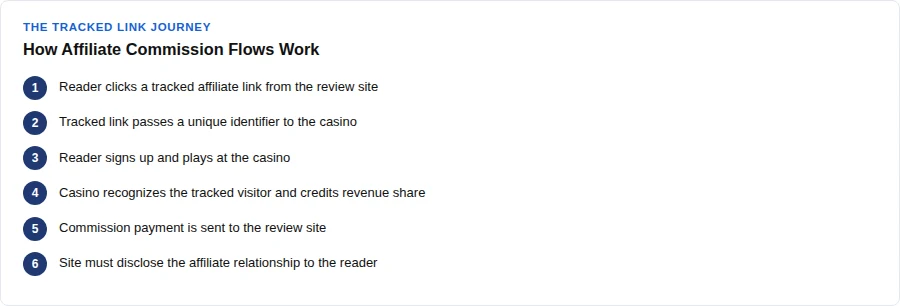
Affiliate marketing is a commission arrangement. A content site, a YouTube channel, or a comparison page sends a visitor to a casino through a special tracked link. If that visitor signs up and plays, the casino pays the site a share of the revenue, or a flat fee per signup. The site functions as an independent contractor, paid on results rather than employed by the casino.
That structure is not sinister by itself. It funds a lot of the free content you read, including plenty of accurate, useful writing. A casino affiliate can be honest, careful, and genuinely helpful. The systemic conflict stems from the payment model. When income depends on which link a reader clicks, the incentive to shape claims becomes structural. Honest operators manage that conflict transparently. Dishonest ones conceal it.
Paid reviews differ from fake reviews. A paid review that clearly says “we earn a commission if you sign up through our links” is disclosure. A page that reads like neutral journalism but is quietly monetized warrants extra scrutiny. The words on the page can be identical between an honest disclosure and hidden monetization; the disclosure itself separates them.
How do I know if a casino review is paid?
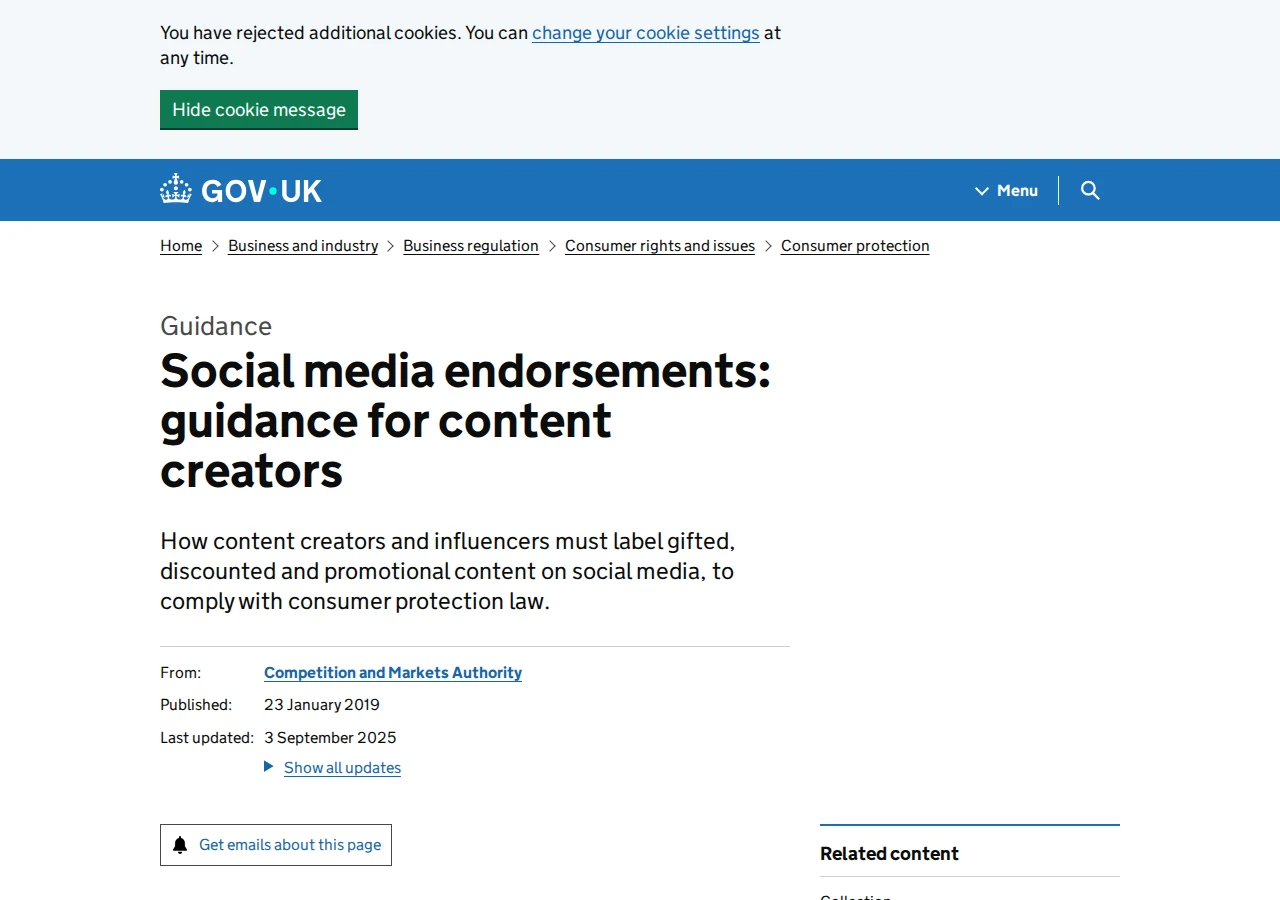
Look for a disclosure statement, and look for where it sits. Regulators in several jurisdictions require clear, unambiguous disclosure of material connections between an endorser and a business, and the general principle is consistent across them. If money changed hands or will change hands, the reader should be able to find that out without hunting.
In practice, that means a real disclosure is easy to find. It sits near the top of the page, or right beside the links, in plain language. It is not a single grey line at the very bottom under the cookie notice. If you have to scroll past three screens of praise to find out who paid, the placement itself is the answer.
Here is the honest-versus-red-flag contrast in one view:
| What honest disclosure looks like | Red flags |
|---|---|
| “We may earn a commission if you sign up through our links.” Near the top or beside the link. | No disclosure anywhere, or one buried below the footer. |
| Names the relationship plainly, e.g., “This is a sponsored placement.” | Vague phrasing like “partner” or “supported by our partners” with no explanation. |
| The site reports drawbacks, not uniform praise. Some casinos get criticism. | Every casino reviewed is “excellent.” Nothing is ever criticized. |
| Links are marked as affiliate links, or the page says links are tracked. | Links look identical to ordinary internal links, with no marking. |
| Contact and ownership details are findable. | No author, no company, no way to ask who is behind the site. |
The single most useful check is the one most readers skip. Does this site ever say anything negative about a casino it promotes? A page that only ever recommends is not reviewing. It is advertising with a review’s layout.
What does a tracked affiliate link actually do?
An affiliate link usually carries a small identifier in the web address, or routes through a redirect, so the casino knows which site sent you. This is how the commission gets credited. The link is not spyware, but it does determine who receives payment for your visit. Your costs remain unchanged.
You can often see this yourself. Hover over a “Play now” or “Visit site” button before clicking. If the address contains a long string of extra characters, or points to a domain that is not the casino’s own, you are looking at a tracked link. Tracked links are normal for affiliate content and only become meaningful when combined with the disclosure question. A tracked link on a disclosed affiliate page is expected; on an undisclosed page, it signals hidden monetization.
This matters for a reason that goes beyond consumer trust. If a page tells you a casino is “safe” and “high-payout” and you believe it because it looked independent, you may sign up and deposit on the strength of a claim that was never checked by anyone. That is a responsible-gambling issue with real financial consequences. Decisions about where to put your money should rest on information you can verify yourself, especially when the recommendation comes from someone paid on commission. The same discipline that applies to how to avoid common online gambling mistakes applies here. Slow down, check the source, and let confidence in prose prompt you to verify further.
What are the concrete signs a “review” is really an ad?
Start with the byline. A real review has a named author with a history, or at least a stated editorial process. An ad often has no author at all, or a generic “Team” that exists nowhere else on the internet. If you cannot find out who wrote the page or who owns the site, treat the recommendation as anonymous marketing.
Then read the structure. Paid placements tend to follow a recognizable template — a breathless opening, a list of “pros” that are really just features, a “cons” section that lists something trivial, and a call to action repeated every few paragraphs. The verdict is decided before the evidence is presented. You can feel it in the pacing.
Here is a checklist you can run in about two minutes on any review page:
- Find the disclosure. Is it above the fold, or hidden at the bottom? If you cannot find one, treat the page’s funding as unverified and apply extra scrutiny to its claims.
- Check the byline. Is there a named author with other work you can find? Or nothing?
- Scan for any negative claim. Does the site ever criticize a casino it links to? A page with zero criticism is a catalogue, not a review.
- Hover the links. Do they carry tracking parameters or redirect through a third domain?
- Look at the “cons.” Are they real drawbacks, or filler like “customer support could be faster”?
- Check the ownership. Who runs the site, and do they say so? A missing “about” page is a missing accountability page.
- Compare two reviews on the same site. If the language, structure, and verdict are near-identical across different casinos, you are reading a template, not an assessment.
These steps require only that you pause and examine the page’s commercial structure alongside its claims.

Why do some sites hide the disclosure?
Because disclosure costs money. A page that says “we are paid by this casino” converts fewer readers than one that reads like neutral advice. The incentive to hide is straightforward, shared with every other form of disguised advertising. Non-disclosure favors conversion whether or not a site intends deception, so the financial structure itself rewards opacity.
A second reason is subtler and more common than deliberate deception. Carelessness drives many undisclosed sites. The writer genuinely believes the casino is fine, the commission feels incidental, and the disclosure gets pushed to a footer because nobody thought it mattered. Carelessness and deception produce identical pages from the reader’s perspective. You cannot distinguish them, so the practical move is to treat an undisclosed page the same way regardless of motive.
This is where the reader’s own habits matter. If you have already decided which casino you want, a paid review is harmless background noise. If you are still deciding, a paid review is doing the deciding for you, and you may not notice. The risk is highest exactly when you are least certain, which is when you are most likely to lean on a confident-sounding page. Recognising that is the whole skill.
Does a paid review have to be dishonest?
No. A paid review can be accurate, and many are. Commissions encourage omission more than outright falsehood. Omission is where most damage occurs. A paid review can mislead through the absence of one sentence that would change your mind, typically about who paid for it.
So the question is not “is this review paid?” Many are, in one way or another. The question is “does this page tell me it is paid, and does it still let me see the drawbacks?” A disclosed affiliate review that names the casino’s weak points is more useful to you than an undisclosed one that pretends to be neutral. The disclosure is what lets you weigh the advice correctly.
Honest sites accept this friction. They carry a disclosure line that interrupts the flow. They admit that a casino they recommend has slow withdrawals. They link to a page explaining how they make money. That friction is the price of trust, and it signals genuine commitment.
How should I use a review once I know it is paid?
Use it as one input among several sources. This content is intended for readers who are of legal gambling age in their jurisdiction. A disclosed affiliate review can still tell you useful things. Check what the sign-up process looks like, what the site’s own terms say, and what the withdrawal limits are. Always verify the praise against the casino’s own published terms. The casino’s terms page is not neutral either, but it is at least the primary source, and it is the document that actually governs your account.
If you are new to this, the same media-literacy habit applies across the whole category. A beginner’s guide to online casinos is useful because it provides frameworks for checking, allowing you to make independent choices. And once you are playing, the tools that protect you, like deposit limits and time reminders, live inside the casino’s own account settings — that is where they have actual effect. Understanding how those work is its own skill, covered in understanding responsible gambling tools. No affiliate page can set them for you, and no affiliate page has an incentive to remind you they exist.
The practical summary is simple. Read the disclosure first, the review second. If there is no disclosure, read the page as an advertisement and adjust your trust accordingly. You will not catch every disguised ad, and you do not need to. You only need to stop treating confident prose as evidence of independence.
FAQ
Are paid casino reviews illegal?
Disclosure requirements vary by country, but the general expectation most regulators share is that a material financial connection should be made clear to the reader. The problem arises when disclosure is absent or hidden. Treat “is this legal here?” as a separate question from “did this page tell me the truth?” A paid recommendation should be clearly labeled as such.
How can I tell if a casino review is sponsored?
Look for a disclosure statement near the top of the page or beside the links, a named author, and at least some criticism of the casinos being reviewed. If you cannot find a disclosure, the page has no byline, and every casino gets a glowing write-up, treat it as sponsored whether or not it admits it. Hovering over the links to check for tracking parameters is a quick confirming step.
What is an affiliate link in a casino review?
It is a link that carries a tracking identifier so the casino knows which site sent you, allowing that site to be paid a commission if you sign up and play. It does not change what you pay. It only determines who gets paid for your visit. On a page that discloses its affiliate relationships, this is normal and expected.
Do affiliate reviews ever tell the truth?
Yes, often. Commissions incentivize leaving things out more than inventing false claims. A disclosed affiliate review can still be accurate and useful. The reliable test is whether the page admits its commercial interest and still reports drawbacks. A review that does both is more trustworthy than one that claims neutrality while hiding its funding.
Is it safe to sign up at a casino based on a review?
Only if you have checked the casino’s own terms and confirmed it is licensed and regulated in a jurisdiction that applies to you. A review, paid or not, is not a substitute for reading the operator’s terms. If a review’s main selling point is a “safe” or “high-payout” claim you cannot verify elsewhere, that claim should not be the reason you deposit.
The pattern is simple enough to carry with you. Money flows from the casino to the page you are reading, and the only question that matters is whether the page says so. You will not always get a clean answer, and no article, including this one, can check a specific site on your behalf. What you can do is stop at the disclosure line before you stop at the verdict, and let the presence or absence of that one sentence tell you how much weight the rest of the page deserves.